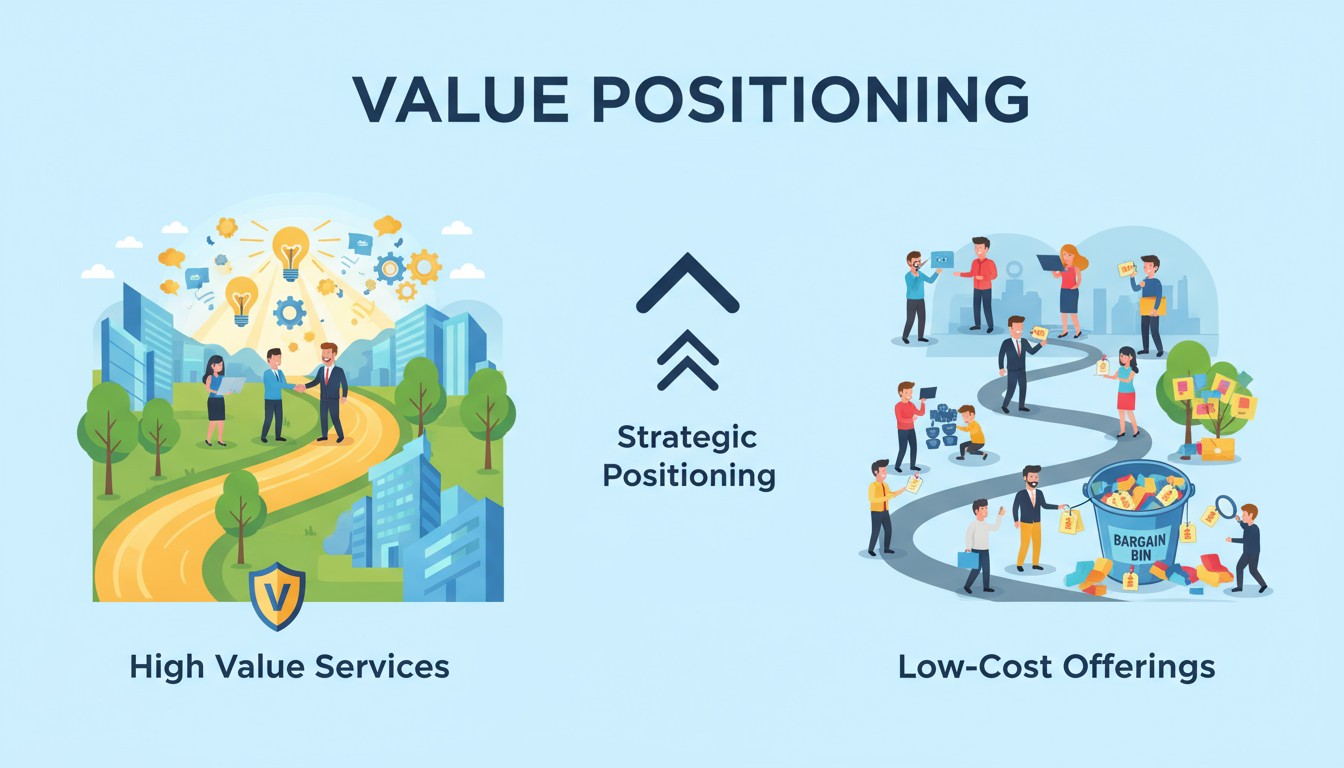
When you set prices for your professional services, the numbers you choose communicate powerful messages to potential clients far beyond just the monetary cost of engaging your services. Pricing functions as a signaling mechanism that shapes who becomes interested in working with you, what expectations they bring to the relationship, how they perceive the value you provide, and ultimately how they treat you throughout your professional engagement. This psychological dimension of pricing creates predictable patterns where budget-conscious pricing strategies intended to make your services accessible and attractive end up selecting for the most challenging clients who approach relationships transactionally while viewing service providers as commodities to be negotiated and squeezed for maximum extraction rather than as valued experts deserving respect and fair compensation for specialized knowledge.
Let me guide you through understanding the psychological mechanisms that connect pricing levels to client quality, why the relationship between low prices and difficult clients proves remarkably consistent across industries and service categories rather than representing coincidental correlation without causal connection, how premium pricing paradoxically attracts better clients who prove easier to work with despite the higher stakes involved in expensive engagements, what specific client behaviors and relationship dynamics change when you shift from budget to premium positioning, and how to make strategic pricing decisions that optimize not just for revenue volume but for the quality of relationships and overall satisfaction you derive from your professional practice. My goal involves helping you see pricing as a client selection tool that determines who chooses to work with you, not merely as a number that affects how much money you earn from whoever happens to purchase your services regardless of their attitudes, expectations, or treatment of you throughout your working relationship.
Understanding How Price Communicates Value Before Work Begins
Think about how consumers use price as a heuristic for judging quality when they lack direct experience or expertise to evaluate products and services objectively. When you encounter two similar-seeming options at dramatically different prices, you instinctively assume the expensive option must be superior because otherwise rational sellers would not price it so high, and buyers would not pay premium prices unless meaningful quality differences justified the cost difference. This quality inference from price represents a universal pattern in human psychology where we use observable signals like price to estimate unobservable qualities like expertise, reliability, or effectiveness when we cannot directly evaluate those qualities ourselves before making purchase decisions.
The research on price-quality perception published by the American Psychological Association demonstrates that this quality inference from price operates even when people have been explicitly told that price differences do not reflect quality differences in the specific context. The psychological association between high prices and high quality runs so deep that it affects our actual experienced satisfaction beyond just our initial expectations, meaning that identical services genuinely feel more valuable and effective when we paid premium prices compared to when we paid budget prices for the exact same deliverables. This means that your pricing shapes not only who decides to work with you but also how much value they perceive in your work regardless of your actual performance quality.
When you price services significantly below market rates, you communicate to potential clients that your expertise or service quality must be inferior compared to higher-priced competitors, because they instinctively assume that if you could command premium prices you would do so rather than charging budget rates. This inference operates unconsciously rather than through deliberate reasoning, meaning clients do not consciously think that your low prices indicate poor quality but rather they feel vaguely uncertain about your capabilities without being able to articulate why your lower pricing makes them less confident in your expertise compared to more expensive alternatives. Some budget-conscious clients will overcome this instinctive wariness because price represents their primary decision criterion, but these price-focused clients represent exactly the segment most likely to prove difficult because their decision-making process prioritized cost savings over quality, expertise, or relationship factors that would have made them value you as more than just the cheapest available option.
Conversely, premium pricing signals that you possess specialized expertise, established reputation, or unique capabilities justifying higher investment, attracting clients who value those qualities and are willing to pay appropriately for genuine expertise rather than seeking the cheapest available provider regardless of capability differences. These premium-oriented clients have already made mental shifts where they understand that professional expertise commands fair compensation, and they seek providers whose pricing reflects confidence in their value rather than desperate attempts to compete primarily on price. The insights from Harvard Business Review on pricing conversations reveal that clients who select premium-priced providers approach relationships differently from budget shoppers in ways that extend far beyond just their willingness to pay higher fees, affecting how they communicate, what expectations they hold, and how they evaluate satisfaction throughout the engagement.
The Budget Client Mindset and Behavioral Patterns
Clients who select service providers primarily based on price rather than expertise or reputation arrive at relationships with fundamentally different mindsets and expectations compared to clients who prioritize quality and are willing to invest appropriately for superior service. Think about what drives someone to choose the cheapest option when meaningful price variations exist across available providers in any professional service category. Sometimes budget constraints genuinely limit their options, forcing them to select affordable providers even when they would prefer premium options if they could afford them. However, more commonly, budget-focused selection reflects values and beliefs about professional services where they view providers as largely interchangeable commodities distinguished primarily by price rather than recognizing expertise variations that justify premium pricing for superior capabilities.
This commodity mindset creates transactional relationship dynamics where budget clients focus intensely on extracting maximum value from minimum investment rather than approaching engagements as partnerships where both parties benefit through fair exchange of expertise for appropriate compensation. You observe this transactional orientation through their communication patterns where they constantly compare your pricing to competitors, negotiate for additional services without corresponding payment, and generally approach every interaction as an opportunity to extract more value beyond what contracts specify. The psychology driving this behavior involves viewing professional relationships as zero-sum games where anything they get without paying represents winning rather than understanding that healthy professional relationships require mutual respect and fair compensation for expertise provided.
Budget clients commonly demonstrate what psychologists call entitlement orientation, where they feel justified making unlimited demands on your time and attention because they are paying customers, regardless of how modest their actual payment is relative to the effort required to serve them adequately. Think about how this manifests when budget clients email at all hours expecting immediate responses, call your personal phone for non-urgent matters because they do not want to wait for business hours, or generally assume that their needs should take priority over your other commitments because the customer-is-always-right mentality they have internalized makes them feel entitled to unlimited accommodation. This entitlement creates exhausting dynamics where you can never do enough to satisfy them because their expectations are not calibrated to what their investment actually warrants, leading to perpetual dissatisfaction regardless of how much you sacrifice trying to exceed expectations that were unreasonable from the beginning.
The comparative mindset that budget clients maintain creates additional difficulties because they constantly evaluate your performance against imagined alternatives rather than appreciating the actual value you deliver in absolute terms. When you complete work that objectively meets all specifications and solves their stated problems, budget clients will still express dissatisfaction if they suspect that competitors might have delivered the same results cheaper or included additional features within base pricing. This constant comparison prevents them from ever feeling genuinely satisfied because satisfaction depends not on whether you delivered what they needed but on whether they believe they got the best possible deal compared to all conceivable alternatives. The research on consumer satisfaction and comparison behavior demonstrates that people who select primarily based on price show significantly lower satisfaction levels than those who prioritize quality, because price-focused decision-making activates comparative mental processes that undermine satisfaction regardless of objective quality delivered.
How Premium Pricing Creates Better Client Relationships
When you charge premium prices that reflect genuine expertise and position you at the higher end of market pricing for your service category, you attract fundamentally different clients who arrive with different mindsets, expectations, and relationship orientations that create more satisfying engagements for both parties. Think about what premium pricing communicates to potential clients beyond just higher cost. It signals confidence in your value, suggesting that you have enough demand from satisfied clients that you do not need to discount prices to attract business. It demonstrates that you view yourself as an expert deserving fair compensation rather than as a desperate vendor willing to undervalue your services to win any available work regardless of client quality or project profitability.
Premium clients who select higher-priced providers have already made mental commitments to investing appropriately for quality rather than prioritizing cost minimization above all other considerations. This investment mindset creates psychological dynamics where they value what they purchased more highly because of the substantial commitment they made, operating through what psychologists call effort justification where people convince themselves that things they invested heavily in must be valuable because otherwise their investment decision would have been foolish. This means premium clients approach relationships already predisposed to appreciate your work and find satisfaction in outcomes, whereas budget clients approach relationships skeptically wondering whether they overpaid and searching for evidence that cheaper alternatives would have been adequate.
The respect differential between premium and budget clients manifests clearly in how they communicate with you and respond to your professional recommendations. Premium clients treat you as an expert whose judgment they trust, implementing your advice without constant second-guessing or seeking validation from cheaper alternatives they could have hired instead. Budget clients continuously question your recommendations, ask whether your suggested approaches really require the investment you propose, and generally demonstrate the wariness of people who suspect they are being upsold unnecessary services because their budget-focused mindset makes them assume all vendors try to extract maximum revenue regardless of client actual needs. This difference in trust fundamentally affects engagement effectiveness because premium clients who implement your recommendations experience the results you promised, while budget clients who half-heartedly implement diluted versions of your advice while seeking cost-cutting shortcuts never experience the full value you could have delivered if they had trusted your expertise enough to follow through properly.
Premium pricing attracts clients who understand that professional expertise takes years to develop through education, experience, and continuous learning that deserves compensation reflecting the investment required to build that expertise. They recognize that paying professional rates represents fair exchange for specialized knowledge they do not possess themselves, whereas budget clients often harbor resentment about professional service fees because they do not fully appreciate the expertise differential justifying the compensation difference between professional rates and what unskilled labor earns. The guidance from business consultants on value-based pricing emphasizes that premium clients who understand professional value creation prove vastly more satisfying to work with than budget clients who view all services as overpriced relative to what they imagine they could accomplish themselves if they just had more time.
The Self-Fulfilling Prophecy of Pricing and Service Quality
An additional dimension connecting pricing to client quality involves how your pricing affects the service quality you can actually deliver, creating self-fulfilling dynamics where budget pricing forces you to cut corners in ways that create the unsatisfying experiences budget clients complain about while premium pricing enables you to invest appropriately in delivery excellence that justifies the higher fees premium clients pay. Think about what happens when you price services so low that you must maximize client volume to generate adequate total revenue. This volume requirement forces you to spread attention across many simultaneous clients rather than focusing deeply on fewer engagements, making it impossible to provide the thoughtful customized service that creates truly excellent outcomes and deeply satisfied clients.
The time pressure created by needing high client volume to compensate for low per-client revenue makes you rush through work rather than investing the extra effort that distinguishes good work from exceptional work. You cannot spend hours researching innovative solutions tailored perfectly to each client’s unique situation because your budget pricing means you earn perhaps two hundred dirhams per hour, making it economically impossible to invest three hours researching approaches that might improve outcomes by twenty percent when that research costs you six hundred dirhams in opportunity cost for time you could have spent serving other budget clients generating immediate billable revenue. This economic reality means budget pricing structurally prevents you from delivering the excellence that would justify higher pricing, trapping you in a cycle where low prices force compromised quality which validates budget clients’ skepticism about whether professional services deserve premium investment.
Premium pricing enables you to serve fewer clients with dramatically more attention and investment per engagement, creating the conditions where you can deliver genuinely exceptional work that premium clients appreciate and that generates the referrals and reputation allowing you to maintain premium positioning. When you earn a thousand dirhams per hour from premium clients, you can afford to spend those three hours researching innovative solutions because the resulting excellence strengthens your reputation and generates referrals to similar premium clients who appreciate that level of investment in their success. This creates virtuous cycles where premium pricing enables quality delivery which justifies premium pricing which enables even better quality delivery as your growing expertise and reputation allow you to command increasing rates that fund continuous capability development maintaining your premium position.
The stress and burnout that budget pricing creates through requiring high volume to achieve adequate revenue affects your ability to show up fully present and energetic for any individual client. When you are constantly exhausted from juggling too many simultaneous engagements necessitated by low per-engagement revenue, every client receives a depleted version of you rather than your best self bringing full creative energy and problem-solving capability to their challenges. Premium clients who pay rates allowing you to maintain sustainable workload receive your best work because you have the mental and physical energy to bring genuine enthusiasm rather than just grinding through obligations to generate enough revenue covering business overhead and personal living expenses. The research on professional burnout and service quality demonstrates that providers working with budget clients at high volumes show significantly higher burnout rates and lower objective service quality metrics compared to providers serving fewer premium clients with sustainable workloads enabling sustained excellence.
Breaking Free From the Budget Trap Through Strategic Repositioning
If you currently serve primarily budget clients and recognize the difficult patterns we have been discussing, transitioning to premium positioning requires deliberate strategic changes beyond just raising prices and hoping better clients appear. Think about what makes premium positioning credible rather than just expensive pricing that potential clients ignore because they see no differentiation justifying higher investment compared to available alternatives. Genuine premium positioning requires developing and communicating clear value propositions that help prospects understand exactly what additional value they receive for the premium investment, whether that involves deeper expertise, more thorough processes, better outcomes, superior service experience, or other meaningful differentiators beyond just paying more for equivalent services.
Specialization represents one of the most powerful paths to premium positioning because deep expertise in narrow domains commands higher rates than generalist services spread across broad areas without particular depth. When you position as a generic web developer competing primarily on price against hundreds of similar providers, you have minimal pricing power because prospects see little differentiation beyond cost. However, when you position as a specialized Shopify expert who exclusively serves e-commerce businesses in the fashion industry, you can command substantial premiums because prospects in that specific niche recognize the value of your specialized knowledge about their unique challenges compared to generalist developers who would need to climb learning curves understanding fashion e-commerce specifics that you already possess through focused specialization.
Building premium positioning requires consciously cultivating reputation signals that communicate expertise credibility to prospects who do not know you personally, including client testimonials from recognizable brands if possible, thought leadership through articles and presentations establishing you as an expert voice in your domain, case studies demonstrating the superior outcomes you achieve for clients, and professional credentials or awards that provide third-party validation of your capabilities beyond just your own claims. These reputation signals allow you to charge premium rates to strangers who lack personal experience with your work because the signals provide sufficient confidence that your premium pricing reflects genuine superior value rather than just ambitious pricing without corresponding expertise to justify the investment. Resources from Inc. Magazine on strategic pricing provide frameworks for building the credibility and positioning enabling premium pricing that prospects accept rather than dismiss as unjustifiably expensive.
Transitioning existing client relationships from budget to premium pricing proves challenging because clients accustomed to low rates resist increases that they perceive as unjustified changes rather than recognizing that your initial budget pricing undervalued services you always should have charged more for. Rather than attempting to raise rates dramatically with existing budget clients who will likely resist and potentially leave, consider maintaining reasonable current client rates while implementing premium pricing for all new clients attracted through your premium positioning efforts. Over time, as existing budget clients naturally churn and new premium clients represent growing proportions of your portfolio, your overall client mix improves toward the premium orientation that enables sustainable professional practice without requiring confrontational conversations with existing clients about why you now charge far more than they have been paying.
The Long-Term Business Impact of Client Quality
Beyond the immediate satisfaction differences between working with budget versus premium clients, the compounding effects over time make client quality one of the most consequential business decisions affecting your long-term success and sustainability. Think about what happens to your business over five years when you serve primarily difficult budget clients versus primarily appreciative premium clients. Budget clients who are never quite satisfied rarely refer new business because they do not enthusiastically recommend services they experienced as merely adequate or disappointing despite getting exactly what they paid for. The few referrals they do provide tend to be similar price-focused clients who will prove equally difficult because people naturally refer others who share their values and decision-making patterns.
Premium clients who receive excellent service and feel their investment was worthwhile generate enthusiastic referrals to their professional networks, which typically include similar premium-oriented prospects who value expertise and are willing to invest appropriately for quality. This referral pattern creates network effects where each satisfied premium client brings several similar premium prospects, allowing your business to grow through referrals from ideal clients rather than requiring constant marketing investment to replace churning budget clients who leave after extracting maximum value at minimum cost then moving to even cheaper alternatives they discovered during their never-ending search for better deals. The compounding power of premium client referral networks versus the exhausting treadmill of constantly replacing departed budget clients makes premium positioning dramatically more sustainable over multi-year timeframes even if initial transition periods prove challenging.
The capability development that premium positioning enables through allowing you to invest in continuous learning, better tools, and process refinement creates widening competitive advantages over time compared to budget competitors who cannot afford similar investments because their thin margins and high client volumes prevent them from ever having sufficient resources or time for the capability building that would let them escape budget positioning. Your five-year investment in specialization, reputation building, and skill development funded by premium pricing creates moats that protect your position from budget competitors who remain trapped serving difficult clients at unsustainable rates without ever building the differentiation that would allow them to charge appropriately for the value they theoretically could provide if they had the resources to develop proper capabilities.
The personal satisfaction and professional pride that comes from doing your best work for appreciative clients who respect your expertise compounds over years to either create thriving sustainable practices that you genuinely enjoy or exhausting treadmills where you constantly question why you continue doing work that feels undervalued and undercompensated despite consuming enormous effort and producing real value that clients simply refuse to acknowledge because their budget-focused mindsets prevent them from appreciating professional expertise properly. The insights from McKinsey research on professional satisfaction demonstrate that compensation matters less for job satisfaction than client quality and feeling that your expertise is valued, meaning that premium positioning improves satisfaction through better client relationships even more than through the higher absolute revenue that premium pricing generates.
Choosing Client Quality Through Strategic Pricing
The pricing psychology principles we explored throughout this discussion reveal that your pricing decisions determine far more than just your revenue per engagement or your total annual income from your professional practice. Pricing functions as a powerful client selection mechanism that shapes who becomes interested in working with you, what expectations they bring to relationships, how they perceive and value your contributions regardless of objective quality you deliver, and ultimately whether you build sustainable satisfying practices serving appreciative clients or exhaust yourself serving difficult people who will never be satisfied because their budget-focused decision-making activated psychological patterns preventing genuine satisfaction regardless of how much you sacrifice trying to exceed expectations that were miscalibrated from the beginning.
Understanding that budget pricing attracts difficult clients while premium pricing attracts better relationships should fundamentally transform how you think about pricing strategy beyond just analyzing what rates the market will bear or what pricing generates maximum short-term revenue volume. Instead, you should view pricing as a strategic tool for building the practice you actually want through attracting clients whose values, expectations, and relationship orientations align with providing mutually satisfying professional engagements where you deliver genuine expertise that they appreciate appropriately rather than serving as a commodity vendor constantly defending your value against people who fundamentally do not understand or respect professional expertise sufficiently to compensate it fairly. You deserve to work with clients who value your contributions rather than constantly negotiating for maximum extraction at minimum cost, and premium pricing represents the most powerful tool available for attracting those quality clients while naturally filtering out the difficult budget-focused prospects who would never appreciate your expertise regardless of how excellently you served them or how much you sacrificed trying to satisfy expectations that budget mindsets make inherently unsatisfiable.