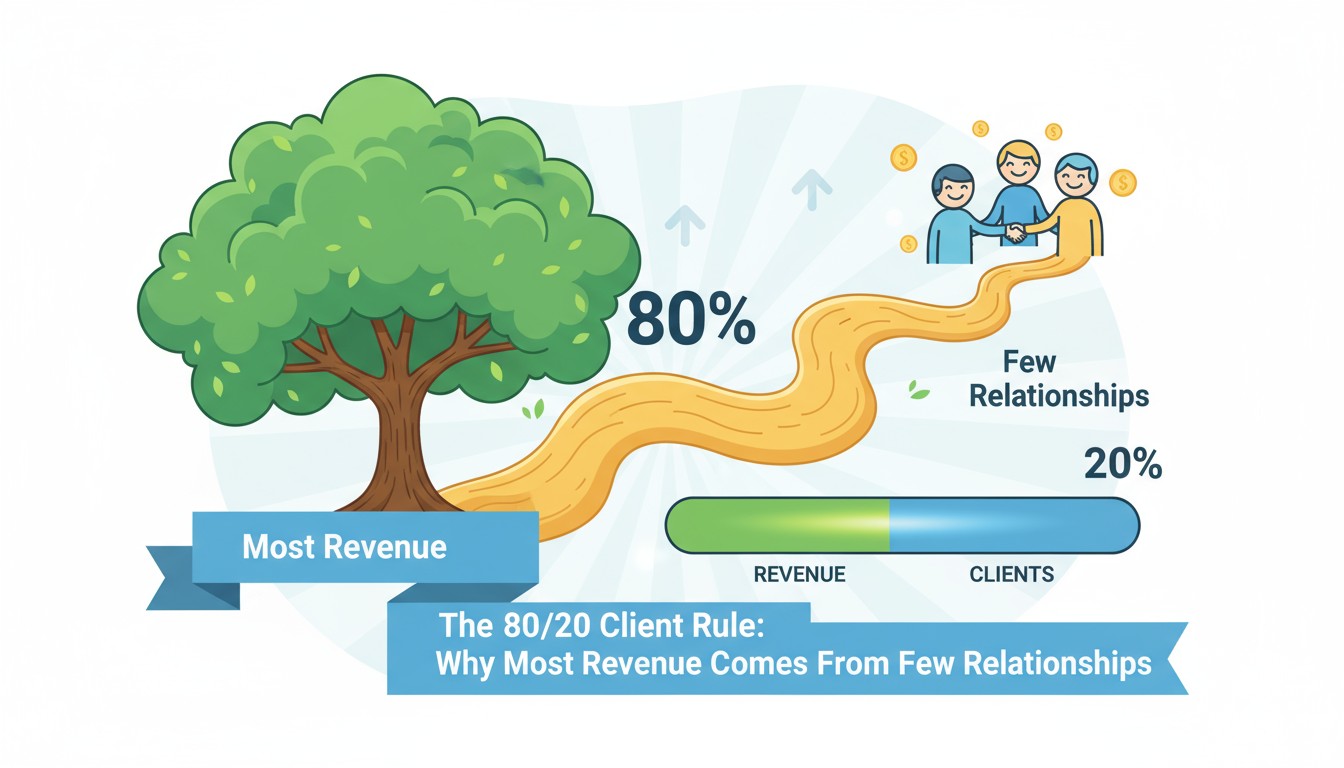
When you examine revenue distribution across client relationships in most service-based businesses, you discover that a small percentage of clients generate disproportionate shares of total revenue while the majority of clients contribute relatively modest amounts despite consuming substantial time and administrative resources. This phenomenon, commonly called the eighty-twenty rule or Pareto principle after the Italian economist who first documented how wealth concentrates unevenly across populations, manifests consistently across industries and business models with remarkable predictability. Understanding why this concentration occurs rather than revenue distributing evenly across all clients helps you recognize which relationships actually drive your business success versus which clients you maintain through inertia or misguided loyalty despite their minimal contribution to your financial sustainability and growth.
Let me guide you through understanding the mathematical and psychological mechanisms that create this revenue concentration pattern, why the specific ratio might be seventy-thirty or ninety-ten in your business rather than exactly eighty-twenty but the underlying principle still applies, how recognizing this pattern transforms your strategic thinking about client acquisition and relationship management, what dangers emerge when you mistake activity for productivity by serving numerous low-value clients instead of deepening relationships with the few clients who actually sustain your business, and how applying eighty-twenty insights systematically throughout your operations creates leverage that multiplies your results without requiring proportional increases in effort or resources. My goal involves helping you see your client portfolio through this analytical lens that reveals which relationships deserve most of your strategic attention and emotional investment versus which clients you should serve adequately but not allow to distract from the vital few relationships that determine whether your business thrives or merely survives.
Understanding Why Revenue Naturally Concentrates
Think about why revenue would naturally concentrate among few clients rather than distributing evenly across your entire customer base. This concentration stems from fundamental dynamics about how business relationships develop over time rather than representing random chance or poor business management. When you acquire new clients, they typically start with small initial projects testing your capabilities before committing to larger engagements or ongoing relationships. Some of these test projects succeed wonderfully, building trust that leads clients to expand the relationship through larger projects, retainer arrangements, or multiple simultaneous engagements across different departments or initiatives. Other initial projects satisfy clients adequately but never develop beyond occasional small projects because various factors prevent deeper relationship development despite technically successful initial work.
The clients who expand relationships over time naturally generate increasingly large revenue shares not because you necessarily provide better service to them than to other clients but because the relationship depth allows them to buy more from you as they develop confidence in your capabilities and organizational familiarity with how to engage you effectively. Think about how this works when a client starts with a five-thousand-dirham project, then comes back for a fifteen-thousand-dirham engagement after the first project succeeds, then establishes a ten-thousand-dirham monthly retainer after several successful projects demonstrate consistent value. Within two years, this single client generates perhaps two hundred thousand dirhams annually while dozens of other clients who never expanded beyond initial projects contribute only five to ten thousand dirhams each despite requiring comparable sales effort and relationship management overhead to acquire initially.
The Harvard Business Review research on customer lifetime value demonstrates that long-term clients typically spend five to ten times more over their relationship lifespan than they did during initial transactions, with this spending increase coming partly from growing trust allowing larger individual projects and partly from increased purchase frequency as clients learn to turn to you for more types of needs rather than limiting engagement to the specific service that initiated the relationship. This spending growth over time means that even if you acquired all clients simultaneously, natural relationship development dynamics would create revenue concentration within a few years as some relationships deepened substantially while others plateaued at modest engagement levels.
Beyond relationship development dynamics, some clients simply have larger budgets and more complex needs than others regardless of relationship tenure, meaning they were always going to generate more revenue than smaller clients with limited budgets or simpler requirements. A multinational corporation implementing enterprise-wide transformations will naturally spend more than a small family business needing occasional consulting regardless of how many small business clients you serve or how well you meet their needs. This inherent size variation across clients combines with relationship development patterns to create the revenue concentration you observe, where a few large clients with deep relationships dominate your revenue while numerous small clients with limited budgets or shallow engagement contribute modestly despite collectively consuming substantial administrative overhead through their sheer numbers.
Calculating Your Actual Client Revenue Distribution
Before you can apply eighty-twenty insights strategically, you need to measure your actual revenue distribution rather than operating on assumptions about which clients matter most that may not reflect reality when you analyze numbers systematically. Think about how this analysis works through a simple exercise you can complete using your accounting system and basic spreadsheet tools. Export your revenue data for the past twelve months showing total revenue from each client, sort this list from highest to lowest revenue, then calculate what percentage of total revenue each client represents and what cumulative percentage the top clients represent when you add them sequentially from largest to smallest.
This cumulative percentage analysis reveals exactly where revenue concentrates in your portfolio. You might discover that your top five clients represent fifty-eight percent of revenue, your top ten represent seventy-four percent, and your top twenty represent eighty-seven percent, meaning that eighty-seven percent of your income comes from just twenty clients while the remaining hundred-plus clients collectively contribute only thirteen percent despite representing the vast majority of your customer base numerically. These specific numbers will vary based on your business model, but the underlying pattern of dramatic concentration almost certainly exists regardless of your industry or service offerings unless you deliberately structured your business to prevent this natural concentration through mechanisms like mandatory minimum project sizes or selective targeting of similar-sized clients.
Extending this analysis beyond just revenue to include profitability often reveals even more dramatic concentration because high-revenue clients frequently prove more profitable per dollar of revenue than small clients who demand disproportionate overhead. When you factor in that large clients typically pay faster, require less hand-holding, respect your expertise more readily, and generate referrals more consistently than small clients who often negotiate prices aggressively and demand extensive support for modest projects, the profitability gap between top clients and the long tail of small accounts becomes enormous. You might discover that your top twenty percent of clients generate not just eighty percent of revenue but ninety-five percent of actual profit after accounting for the full costs of serving different client segments including the opportunity costs of time spent on low-value relationships that could have been invested in deepening high-value relationships or acquiring similar high-value clients.
This analysis should also examine revenue stability over time by tracking which clients provide consistent recurring revenue versus which clients make occasional purchases with long gaps between engagements. Clients providing predictable monthly retainers or quarterly projects scheduled far in advance contribute more to business stability than clients generating equivalent annual revenue through sporadic unpredictable projects that leave you uncertain about cash flow and capacity planning. When you combine revenue size with stability metrics, you typically find that a very small group of clients provides both the majority of revenue and the stability that allows you to plan confidently and invest in growth rather than constantly scrambling to replace revenue from departed clients or fill gaps between irregular projects.
The Hidden Costs of Serving Too Many Small Clients
Understanding that most revenue concentrates among few clients matters because the inverse pattern often proves equally true in reverse, where most of your time and administrative burden gets consumed by numerous small clients contributing little revenue. Think about what happens when you have one hundred twenty clients generating an average of twelve hundred dirhams annually each. These clients collectively represent one hundred forty-four thousand dirhams in revenue, which sounds substantial until you realize that this revenue gets spread across one hundred twenty separate relationships requiring individual account management, billing, tax documentation, communication, and relationship maintenance regardless of how much each relationship generates.
The fixed overhead associated with maintaining any client relationship means that small clients often prove unprofitable when you properly account for all costs. Each client requires you to maintain accounting records, send invoices, process payments, manage contracts, handle tax documentation, respond to emails and calls, attend periodic meetings, and generally invest relationship management time that has minimal correlation with revenue size because a client paying twelve hundred dirhams annually demands nearly as much administrative attention as clients paying twenty-five thousand dirhams. The McKinsey research on customer service economics demonstrates that the bottom twenty percent of customers by revenue typically cost more to serve than they generate in gross margin, making them net losses that businesses subsidize through profits from top customers who generate enough margin to cover their own costs plus the losses from unprofitable small accounts.
Beyond direct costs, small clients create enormous opportunity costs by consuming time you could invest in deepening relationships with high-value clients or acquiring similar high-value prospects. When you spend an afternoon resolving a billing dispute with a client who pays fifteen hundred dirhams annually, you sacrifice the opportunity to have a strategic planning session with a major client that might lead to expanding their engagement or generate a valuable referral to similar high-value prospects. These opportunity costs never appear in accounting systems but represent your most significant losses from maintaining too many small unprofitable relationships, because time represents your scarcest resource and directing it toward low-value activities necessarily means not directing it toward high-value activities that would generate far superior returns.
The psychological burden of managing numerous client relationships adds another hidden cost as you experience constant context switching between different client needs, expectations, and communication styles. Research on cognitive costs of multitasking shows that switching between tasks reduces productivity by up to forty percent compared to sustained focus on single priorities, yet maintaining large client portfolios forces you into constant switching as different clients demand attention simultaneously. When you have five major clients generating most revenue, you can develop deep knowledge of each client’s business and maintain continuous strategic thinking about their needs. When you juggle one hundred twenty clients, you necessarily maintain only surface-level relationships with most clients while experiencing perpetual overwhelm from trying to remember details about businesses you rarely engage with deeply enough to develop genuine expertise about their situations.
Strategic Implications for Client Acquisition and Portfolio Management
Recognizing that revenue concentrates among few clients should fundamentally transform how you think about client acquisition priorities and where you invest relationship development energy. Instead of pursuing every potential client regardless of size or treating all clients equally once acquired, you should deliberately focus acquisition efforts on prospects matching the profile of your current top-tier clients while investing relationship management energy disproportionately in your highest-value relationships rather than spreading attention evenly across your entire portfolio. Think about how this strategic focus differs from the egalitarian approach most businesses adopt where they attempt to serve all clients excellently regardless of revenue contribution because treating some clients as more important than others feels uncomfortable or potentially unfair.
This discomfort with explicitly prioritizing certain clients over others stems from confusing equality of treatment with equity of investment, when actually equity demands providing service appropriate to the value each relationship represents rather than identical service regardless of contribution. You provide all clients with professional competent service meeting contracted obligations, but you invest additional strategic thinking, proactive outreach, preferential scheduling, and relationship development energy in clients whose revenue contribution justifies that incremental investment. When top-tier clients request meetings, you accommodate their scheduling preferences even when inconvenient because maintaining and expanding these critical relationships justifies the accommodation. When small clients request similar scheduling flexibility, you politely offer available standard times without contorting your schedule because their modest contribution does not justify the disruption that accommodating their preferences would create.
Client acquisition should target organizations matching characteristics of your existing top clients rather than accepting any paying customer regardless of whether they fit the profile that predicts high lifetime value. When you analyze your top clients, you likely find they share patterns in industry, company size, growth stage, decision-making style, or other characteristics that distinguish them from small clients who never expand beyond minimal engagement. By deliberately targeting prospects matching this top-client profile, you increase the probability that new acquisitions will develop into high-value relationships rather than joining the long tail of small accounts consuming disproportionate overhead. The guidance on ideal customer profile development helps businesses identify and target prospects most likely to become valuable long-term clients rather than accepting all prospects indiscriminately regardless of fit with your successful client patterns.
Portfolio pruning represents the natural complement to focused acquisition, where you systematically exit relationships with clients who consistently rank in the bottom tier of your revenue distribution while consuming disproportionate overhead through their demands, payment delays, or general difficulty that makes serving them exhausting relative to their modest contribution. Think about how this works when you identify twenty clients who each generate less than two thousand dirhams annually while requiring comparable relationship management to clients paying twenty thousand dirhams. Rather than continuing to serve these unprofitable relationships indefinitely, you might implement minimum engagement requirements that naturally cause small clients to either increase spending to justify continued service or exit to find providers whose business models accommodate very small accounts more economically than your higher-overhead structure allows.
Deepening Relationships With Your Vital Few Clients
Once you identify the small number of clients generating most revenue and profit, you can develop systematic approaches for deepening these critical relationships to increase both their stability and their growth potential. Think about what deepening relationships actually means beyond just doing good work on contracted projects. Deep relationships involve understanding clients’ businesses thoroughly enough to proactively identify opportunities where you can help rather than waiting for them to request specific services, developing personal connections with multiple stakeholders within client organizations so your relationship survives individual personnel changes, and generally positioning yourself as indispensable strategic partner rather than interchangeable service provider who could be easily replaced by competitors offering similar capabilities at slightly lower prices.
Proactive value delivery through identifying client needs before they explicitly request help demonstrates your deep business understanding while also expanding the relationship beyond the specific services that originally defined your engagement. When you notice through industry news or client conversations that regulatory changes will create compliance challenges requiring exactly the expertise you possess, reaching out proactively to offer assistance before they realize they need help positions you as strategic advisor rather than passive vendor waiting for instructions. This proactive stance requires investing time to understand client businesses deeply and monitor their industry environments for relevant developments, which obviously makes sense for clients generating substantial revenue but represents poor investment for small clients whose modest contribution cannot justify the time required for this level of strategic engagement.
Relationship diversification within client organizations protects against key person risk where your entire relationship depends on a single internal champion whose departure would jeopardize the engagement regardless of the value you provide to the organization overall. Think about what happens when your primary contact who loves working with you accepts a job at another company. If your relationship existed solely with that individual rather than being integrated throughout the organization, you face substantial risk that their replacement will want to bring in their own preferred vendors rather than continuing relationships they inherited. By deliberately building connections with multiple stakeholders across different departments and levels within high-value client organizations, you create resilience that survives individual personnel changes while also expanding the surface area through which additional work opportunities can enter your relationship.
Strategic business reviews or quarterly planning sessions formalize your position as strategic partner rather than transactional vendor by creating structured opportunities for discussing client business challenges and opportunities beyond immediate project work. During these sessions, you might review work completed during the past quarter, discuss results achieved and lessons learned, explore upcoming challenges where your expertise could help, and generally maintain strategic dialogue about how you can contribute to client success rather than limiting interaction to project-specific tactical communications. Resources from Gartner on strategic account management provide frameworks for structuring these high-value client relationships in ways that deepen engagement and expand revenue over time through systematic relationship development rather than hoping relationships naturally deepen without deliberate cultivation effort.
Balancing Concentration Risk With Portfolio Diversification
While focusing on high-value clients makes strategic sense, extreme revenue concentration creates vulnerability where losing a single client threatens your entire business viability. Think about what happens when one client represents sixty percent of your revenue and they experience budget cuts forcing them to reduce spending or they get acquired by another company that prefers using their existing vendors rather than continuing your relationship. Suddenly you lose more than half your revenue, creating cash flow crises and potentially forcing layoffs or business contraction that could have been avoided through more balanced revenue distribution that would have made any single client departure manageable rather than catastrophic.
The appropriate balance between concentration and diversification depends on your risk tolerance, financial reserves, and industry stability, but general guidance suggests that no single client should represent more than twenty-five to thirty percent of total revenue to maintain acceptable risk levels. When clients exceed this concentration threshold, you should either work to expand your overall business so their absolute spending stays flat while representing declining percentage of growing total revenue, or you should deliberately invest in acquiring additional high-value clients to dilute individual client concentration even though you would prefer to simply deepen existing relationships that already work well rather than investing in new client development that requires substantial effort with uncertain returns.
This diversification requirement means you need a systematic client development pipeline ensuring you continuously cultivate new high-value relationships rather than becoming complacent because current top clients generate sufficient revenue without needing additional growth. The challenge involves maintaining business development discipline even when current revenue feels adequate, because the time to develop new major clients is before you lose existing major clients rather than waiting until departures create revenue crises forcing desperate acquisition efforts. Insights from Bain research on customer strategy emphasize that sustainable businesses maintain balance between serving existing high-value clients excellently while simultaneously investing appropriate resources in acquiring the next generation of major relationships that will eventually replace current top clients when they inevitably depart through natural business lifecycle events.
Applying Eighty-Twenty Thinking Throughout Your Operations
Beyond just client revenue distribution, the eighty-twenty principle applies throughout your business operations in ways that create leverage when you recognize these patterns and act on their implications systematically. Think about how the same concentration dynamics appear in which services generate most profit, which marketing activities produce most qualified leads, which team members create most value, and generally across every aspect of business operations where you can measure inputs against outputs to identify which small fraction of activities generates disproportionate results while the majority of activities contribute modestly despite consuming substantial resources.
Service profitability often concentrates dramatically where perhaps twenty percent of your service offerings generate eighty percent of profit while the remaining eighty percent of services you offer contribute minimal profit or actually lose money when you properly account for all delivery costs. When you analyze which services clients buy most frequently, generate highest margins, require least overhead to deliver, and create fewest problems or rework cycles, you typically find a small subset of your total service portfolio drives most profitability while many services you maintain out of tradition or perceived client expectations barely justify the costs of keeping them available. By focusing marketing and sales efforts on your most profitable services while potentially pruning unprofitable offerings that consume overhead without contributing meaningful margin, you improve overall profitability substantially without requiring revenue growth.
Marketing channel effectiveness follows similar patterns where perhaps two out of ten marketing activities you pursue generate eighty percent of qualified leads while the remaining eight activities contribute marginally despite consuming time and budget that could be redirected toward the most productive channels. When you track which marketing efforts actually convert to valuable clients rather than just generating activity or vanity metrics like website traffic or social media followers, you often discover that a specific conference, one strategic partnership, or a particular content marketing approach drives most actual business development while numerous other activities you maintain because they seem like what you should do contribute little to actual client acquisition. The HubSpot research on marketing effectiveness consistently shows that businesses achieve better results by concentrating resources on their most productive channels rather than spreading effort across numerous channels in attempts to maintain presence everywhere regardless of demonstrated effectiveness.
Team productivity distributions reveal similar concentration where your highest-performing team members often contribute three to five times more value than average performers, meaning that a small percentage of your team generates disproportionate client satisfaction, revenue, innovation, and problem-solving while others contribute adequately but not exceptionally despite representing majority of headcount. Recognizing these performance distributions should influence how you allocate development resources, compensation, and stretch opportunities by investing disproportionately in retaining and developing your top performers whose departure would create far greater impact than losing average performers even though egalitarian impulses might suggest treating all team members identically regardless of contribution differences. The research from MIT Sloan Management Review demonstrates that organizations achieving highest performance systematically identify and invest in their vital few highest performers rather than distributing development resources equally across all employees.
Moving From Activity to Impact Through Focus
The fundamental insight that eighty-twenty analysis provides involves distinguishing between activity that makes you feel busy versus impact that actually drives business results and growth. Think about how easy it becomes to fill entire days with client meetings, email responses, administrative tasks, and general busyness that creates the feeling of productive work without actually moving your business forward in meaningful ways. When you serve one hundred twenty clients, you can easily spend entire weeks responding to their various requests, managing their expectations, and handling relationship maintenance without ever investing time in strategic activities like deepening your top client relationships, developing major new prospects, or improving service delivery in ways that would compound over time to multiply your effectiveness and impact.
This activity trap where busy-ness substitutes for genuine productivity stems partly from how immediate demands always feel more urgent than important strategic work that lacks deadlines or external pressure. When a small client emails requesting immediate response to a minor question, responding feels urgent even though their modest contribution means the response creates minimal business value. When you have an opportunity to reach out proactively to a major client with a strategic insight that could lead to expanding the relationship, this outreach feels like it can wait because nobody is demanding immediate action, yet this strategic outreach potentially creates far more business value than responding to dozens of small client requests even though the outreach requires comparable time investment as answering a few quick questions.
Breaking free from activity traps requires deliberately scheduling time for high-impact strategic work before filling your calendar with meetings and reactive tasks that consume all available time if you allow them to. You might block every Monday morning for strategic client relationship development where you review your top clients, identify proactive outreach opportunities, prepare for upcoming strategic reviews, or develop thought leadership content that positions you as indispensable advisor they cannot imagine operating without. By protecting this strategic time before allowing meetings and routine work to fill your schedule, you ensure that your most important work actually happens rather than perpetually getting displaced by urgent but less important activities that expand to consume whatever time you leave available for them.
Leveraging Concentration for Sustainable Growth
The eighty-twenty principle we explored throughout this discussion reveals that your business success depends far more on a vital few relationships than on the trivial many clients who collectively contribute modest revenue while consuming disproportionate overhead through their sheer numbers requiring individual relationship management. Understanding this concentration pattern transforms how you think about client acquisition by focusing efforts on prospects matching your top client profile rather than accepting any paying customer regardless of fit, how you allocate relationship management energy by investing disproportionately in your highest-value clients rather than spreading attention evenly across your entire portfolio, and how you make portfolio management decisions by systematically pruning unprofitable small clients that drain resources without contributing meaningful value to your business sustainability or growth.
Applying eighty-twenty thinking consistently throughout your operations creates leverage that multiplies results without requiring proportional increases in effort because you systematically focus resources on the vital few activities, relationships, and initiatives that drive disproportionate impact while reducing investment in the trivial many activities that create busy-ness without meaningful contribution to your strategic objectives. This focus does not mean ignoring small clients or neglecting less productive activities entirely, but rather calibrating your investment appropriately to the value different relationships and activities provide rather than treating everything as equally important despite dramatic differences in actual contribution. By developing the discipline to identify and concentrate on your vital few clients while adequately but efficiently serving the rest of your portfolio, you build sustainable businesses that generate growing revenue without proportional increases in complexity or overhead, because growth comes through deepening your most valuable relationships and acquiring similar high-value clients rather than through accumulating ever-larger numbers of small unprofitable accounts that create the illusion of business development while actually undermining profitability and consuming the time you should invest in relationships and activities that genuinely drive your long-term success and sustainability.